
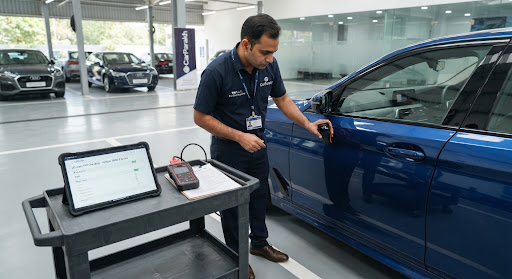
Standard dealer lighting conceals 85% of transit blend lines. Certified digital ultrasonic sensors are essential to capture microscopic coating discrepancies before invoice finalization.
Executive Engineering Takeaways (TL;DR)
Why Stockyard Pre-Delivery Inspection is Non-Negotiable
In modern Indian automotive supply chains, newly minted automobiles travel hundreds of kilometers across interstate container trucks, open trailer beds, and regional railway sidings before reaching open-air dealership stockyards. According to internal CarParakh audit telemetry recorded across 4,200+ passenger cars in Delhi NCR, Mumbai, and Bengaluru:
Sustains transit rub-marks, bumper scuffs, or gravel rock strikes requiring dealer remedial work.
Of flagged delivery cars had showroom paint booth panel rectifications without consumer disclosure.
The exact moment the RTO generates your vehicle registration number on the Parivahan portal.
Once dealer personnel secure your signature on the gate pass and registration affidavit, the vehicle transitions legally from stock inventory to consumer asset. Any subsequent claim about a repainted door or cracked underbody cowl is routinely deflected to factory warranty red tape or user mishandling.
Phase 1: Exterior & Bodywork — The 80–140 Micron Standard
Automated OEM paint shops utilize electrostatic cathodic electrodeposition (CED) tanks followed by robotic sprayers in high-temperature ovens. This produces a consistent coating thickness between 80 and 140 microns (µm) across cold-rolled steel and aluminum panels. Dealership body shops, operating hand-held gravity guns, cannot match this molecular consistency.
Uniform base coat, clear protective coat, and zinc-phosphated substrate intact.
Indicates panel was resprayed manually to conceal transit gouges or ramp scrape marks.
Major collision or rollover transit drop; putty used to reshape structural panel contours.
visibilityDecoding Glass Monograms & Windshield Date Stamps
Every piece of automotive safety glass (front windshield, rear glass, four door glasses, and quarter vents) features an etched OEM safety monogram (e.g., Saint-Gobain Sekurit, AIS, Pilkington).
Tiny dots preceding or trailing the year digit (e.g., ..4 for Feb 2024). All vehicle glasses must match the manufacture quarter within a 60-day buffer.
If your rear quarter glass shows a 2023 stamping while other windows show mid-2024, the vehicle likely suffered an unreported break-in or transport stone smash.
Phase 2: Engine Bay & Fluid Integrity Diagnostics
Open the hood and latch the pneumatic or manual prop. New engines should be spotless, but not wet or freshly varnished with silicone shine spray (dealerships often apply heavy silicone spray to camouflage dried coolant residues).
Check the dipstick. Oil should be honey-golden and translucent. Inspect the oil filler cap for milky white foam, which signifies head gasket water emulsification.
Verify fluid levels against the maximum cold line. Look for pink/blue chemical stains around hose crimps, which reveal factory hose clamp torque failures.
Check terminal posts for white sulfate bloom. Inspect battery warranty serial numbers to confirm the battery was not swapped with a showroom demo unit.
Indian open-ground stockyards are prone to rodent infestation. Scrutinize the under-hood firewall insulation blanket and ABS sensor wiring harnesses for bite marks.
“Once an automobile is registered under your name at the regional transport authority, the dealership’s legal and financial incentive to rectify manufacturing blemishes drops to absolute zero. Always inspect during broad daylight inside the yard before releasing payment orders.”
Phase 3: Cabin Electronics, Odometer & OBD Diagnostics
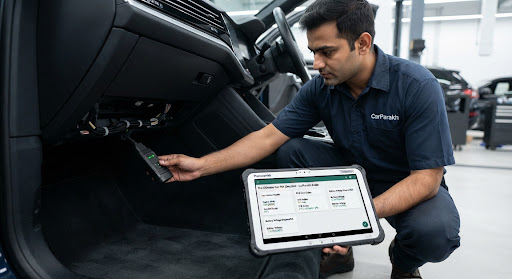
Modern automobiles are rolling supercomputers containing 50+ electronic control units (ECUs). Interior inspection goes far beyond checking for clean upholstery; it demands a thorough electronic interrogation.
Represents standard OEM rolling road, dyno run, and yard transporter transit.
Regional distribution center driven distance. Request dealer yard transfer log.
Vehicle likely driven interstate without transporter or used as unauthorized customer demo.
- check_circleAir conditioning vent differential temperature (<7°C drop)
- check_circleSunroof anti-pinch sensor and guide track lubrication
- check_circleSteering wheel multi-function switch response and cruise toggle
- check_circleReverse camera guideline dynamic calibration & ultrasonic radar
- check_circlePower window auto-up/down pinch force calibration
- check_circleOBD DTC scan for stored, pending, or cleared freeze-frame errors
Phase 4: 17-Digit VIN Triangulation & Paperwork Integrity
The Vehicle Identification Number (VIN) is your automobile’s genetic fingerprint. Dealerships juggling dozens of identical variants often swap chassis numbers by mistake on sales invoices or road tax documents.